 how-to
How to Calm Your Nervous System: Proven Steps
Table of Contents
- Signs of Nervous System Dysregulation You Shouldn't Ignore
- How to Get Out of Fight or Flight Mode: The Physiology First
- Somatic Grounding Techniques to Calm the Nervous System Fast
- Daily Routine to Calm the Nervous System Long-Term
- Acute vs. Chronic Regulation: Why the Distinction Matters
- Trauma-Informed Considerations for Veterans and First Responders
- Physiological Markers That Show Your Nervous System Is Healing
- Frequently Asked Questions
Last Updated: September 1, 2026
Signs of Nervous System Dysregulation You Shouldn't Ignore
A dysregulated nervous system is not a character flaw, it is a physiological state in which the autonomic nervous system becomes stuck in patterns of sympathetic activation never meant to run continuously. The fight or flight response is a survival mechanism designed for short-term threats, but when it never fully switches off, chronic dysregulation results.
At Spence's True North, we work with veterans, first responders, and trauma survivors who often describe the same cluster of symptoms without realizing they share a common root.
Common signals include:
- Chronic muscle tension, particularly in the jaw, shoulders, and neck
- Difficulty falling or staying asleep despite exhaustion
- Hypervigilance: scanning for threats in safe environments
- Emotional reactivity disproportionate to the situation
- Digestive disruption, including nausea or irritable bowel patterns
- Persistent numbness or emotional flatness
- Difficulty concentrating or completing routine tasks
Nervous system dysregulation occurs when the autonomic nervous system oscillates erratically between sympathetic overdrive and parasympathetic collapse, failing to return to homeostasis after a stressor has passed. This reflects a system conditioned by repeated trauma or chronic occupational exposure to treat the baseline as dangerous.
The good news: the nervous system is plastic and can relearn safety with the right inputs.
How to Get Out of Fight or Flight Mode: The Physiology First
Understanding why these techniques work makes them stick. The autonomic nervous system has two primary branches: the sympathetic branch accelerates the body (raising heart rate, blood pressure, and cortisol), while the parasympathetic branch slows it (deepening breathing, restoring digestion and repair). These systems are meant to balance each other in homeostasis.
When trauma or chronic stress keeps the sympathetic branch dominant, the body cannot access parasympathetic states reliably. Every technique aims at the same goal: shift toward parasympathetic dominance, activate the body's natural calming mechanisms, and rebuild self-regulation capacity.
Breathing Techniques That Activate the Parasympathetic Nervous System
Diaphragmatic breathing is one of the most direct routes to parasympathetic activation. Slow, deep exhales stimulate the vagus nerve, which signals safety to the brain.
The physiological sigh, documented in research from Stanford University's neuroscience department, involves a double inhale through the nose followed by a long exhale through the mouth. Many people find this single breath pattern produces noticeable calm within 30 seconds.
Box breathing protocol (4-4-4-4):
- Inhale slowly through the nose for 4 counts
- Hold the breath for 4 counts
- Exhale completely through the mouth for 4 counts
- Hold empty for 4 counts
- Repeat 4-6 cycles
The extended exhale is the active ingredient. An exhale longer than the inhale consistently shifts the ratio of sympathetic to parasympathetic tone.
Vagus Nerve Stimulation Through Humming and Vocal Toning
Humming is underrated. The vagus nerve runs through the larynx, and sustained vocal vibration stimulates it directly. This is why people instinctively hum to self-soothe.
How to use humming for vagus nerve stimulation:
- Sit comfortably with your spine supported
- Take a full breath in through the nose
- Exhale slowly while producing a sustained "hmmmm" sound
- Feel the vibration in your chest and throat
- Repeat for 5-10 breath cycles
Vocal toning extends this principle using sustained vowel sounds. The "OM" sound used in meditation traditions and the "voo" sound used in somatic experiencing practices both activate the same parasympathetic pathway.
Somatic Grounding Techniques to Calm the Nervous System Fast
Grounding exercises redirect attention from internal threat-narratives to present-moment sensory input. When someone is flooded by anxiety, their interoceptive signals are overwhelmed by the fight or flight response. Grounding interrupts that loop.
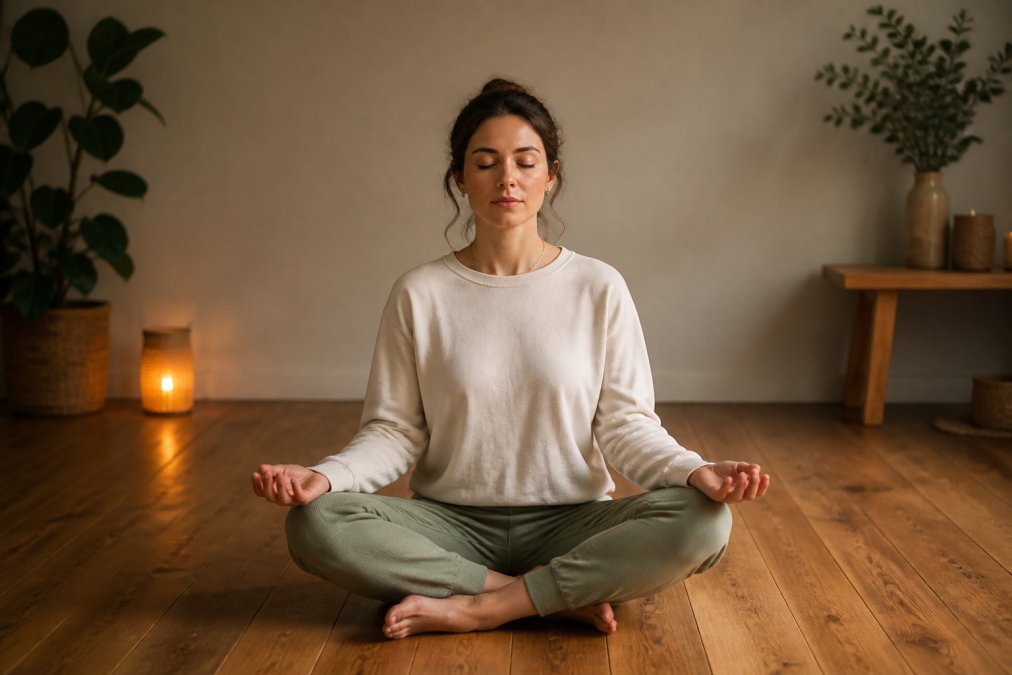
The 5-4-3-2-1 technique systematically engages all five senses, pulling attention out of the threat-response loop and back into the present environment.
5-4-3-2-1 grounding protocol:
- Name 5 things you can see right now
- Name 4 things you can physically touch, and touch them
- Name 3 things you can hear in your immediate environment
- Name 2 things you can smell
- Name 1 thing you can taste
This sequence activates the prefrontal cortex, which helps regulate the amygdala's alarm signals. Most people experience measurable reduction in acute sympathetic activation within two to three minutes.
Self-soothing touch, including placing a hand on the sternum or crossing the arms across the chest, activates oxytocin pathways. This is a physiological mechanism, not a soft suggestion.
Progressive Muscle Relaxation: Step-by-Step
Progressive muscle relaxation reduces physical tension by deliberately contracting and releasing muscle groups in sequence. The body cannot hold full muscular tension and simultaneously access the parasympathetic state.
Full-body progressive muscle relaxation (allow 15-20 minutes):
- Lie flat or sit in a supported chair. Close your eyes.
- Begin with your feet: curl your toes tightly for 5 seconds, then release completely for 15 seconds. Notice the contrast.
- Move to your calves: flex them hard, hold 5 seconds, release 15 seconds.
- Continue upward through thighs, abdomen, hands (make fists), forearms, biceps, shoulders (raise toward ears), and face (scrunch all muscles).
- At each release, breathe out slowly and allow the muscle to go completely soft.
- End with three full diaphragmatic breaths.
The contrast between tension and release teaches the nervous system what relaxation actually feels like. Many people living with chronic dysregulation have lost this reference point.
Cold Exposure, Mindful Movement, and Self-Soothing
Cold exposure, specifically brief cold water on the face or wrists, triggers the mammalian dive reflex and produces a rapid drop in heart rate through vagus nerve stimulation. Splashing cold water on the face for 30 seconds activates the parasympathetic nervous system through a well-documented physiological pathway.
Mindful movement, including slow yoga, tai chi, or a deliberate five-minute walk with attention on each footfall, combines somatic awareness with gentle physical activation. This differs from high-intensity exercise, which can temporarily increase sympathetic tone. In acute dysregulation, slower and more deliberate movement is more effective than intensity.
Schedule a free consult call →
Daily Routine to Calm the Nervous System Long-Term
A single breathing exercise will not heal a chronically dysregulated nervous system. Lasting change comes from consistency: small, repeated inputs that gradually shift the system's baseline toward regulation. Think of it as recalibrating a thermostat rather than briefly cooling a room.

Time of Day | Practice | Duration | Primary Effect |
|---|---|---|---|
Morning | Intentional breathing + somatic check-in | 5-10 min | Parasympathetic activation |
Midday | 5-4-3-2-1 grounding or brief walk | 3-5 min | Acute stress reset |
Evening | Mindfulness practice + social connection | 15-20 min | Cortisol reduction |
Pre-sleep | Progressive muscle relaxation | 10-15 min | Nervous system wind-down |
Morning Anchors: Intentional Breathing and Somatic Awareness
The first 20 minutes after waking set the autonomic tone for the day. Cortisol naturally peaks in the morning. Introducing intentional breathing before reaching for a phone or screen keeps that cortisol spike from triggering a sympathetic cascade.
A morning somatic awareness practice is simple: before getting out of bed, take three slow diaphragmatic breaths and do a brief body scan from feet to head. Notice where tension is already present. This develops interoceptive awareness, the capacity to notice what the body is doing before it escalates.
This morning anchor is a foundational element of the T.R.U.E. North Protocol at Spence's True North, which structures these daily practices within a 25-week framework designed specifically for veterans, first responders, and trauma survivors.
Evening Wind-Down: Mindfulness and Social Connection
The evening is where most people lose their nervous system regulation gains. Screens, unresolved work stress, and social isolation all sustain sympathetic activation into the hours when the body needs to shift toward parasympathetic dominance for sleep.
Mindfulness-based stress reduction practices, including a 10-minute body scan or guided meditation, have substantial clinical support for reducing cortisol levels and improving sleep onset. According to the American Psychological Association's resources on stress and mindfulness, regular mindfulness practice produces measurable changes in autonomic regulation over time.
Social connection is essential for nervous system health. Laughter, genuine conversation, and physical proximity to trusted people all activate the ventral vagal pathway, the branch of the parasympathetic nervous system associated with safety and social engagement.
Acute vs. Chronic Regulation: Why the Distinction Matters
Acute regulation means managing a nervous system currently activated: using breathing, grounding, or cold exposure to bring down an immediate stress response. These tools work quickly and are essential, but they do not change the underlying baseline.
Chronic regulation means changing the system's set point over time. This requires consistent daily practice, often over months, and frequently involves processing the underlying trauma or chronic stressor keeping the system dysregulated. Techniques like progressive muscle relaxation, mindfulness practice, and guided journaling work at this deeper level when applied consistently.
If you have been using acute tools for months without improvement in your baseline, the intervention needs to shift. Acute tools are first aid. Chronic regulation is rehabilitation.
Trauma-Informed Considerations for Veterans and First Responders
Standard stress-management advice was not designed for people who have been in combat, responded to mass casualty events, or worked years of overnight shifts in emergency medicine. A trauma-informed approach recognizes several critical distinctions.
First, some grounding techniques can backfire. Closing the eyes in a body scan can increase hypervigilance in someone with active PTSD symptoms. Keeping the eyes open and softly focused on a neutral point is often a better entry point.
Second, nervous system dysregulation in veterans and first responders is frequently compounded by moral injury: the specific distress from participating in, witnessing, or failing to prevent events that violate one's moral code. Moral injury does not respond to breathing exercises alone.
Third, confidentiality concerns are real and legitimate. As documented by the VA's resources on PTSD and stigma in military populations, stigma and confidentiality concerns remain significant barriers to care. A coaching environment outside the chain of command addresses this directly.
The T.R.U.E. North Protocol at Spence's True North was built with this population in mind. It combines neuroscience-based nervous system regulation with guided grief work and journaling, delivered in a confidential coaching environment that understands occupational trauma.
Physiological Markers That Show Your Nervous System Is Healing
Subjective improvement matters, but objective markers help, especially for people who have been in survival mode so long they struggle to trust their own internal signals.
Heart rate variability (HRV) is the most accessible physiological marker of nervous system health. HRV measures the variation in time between heartbeats. Higher HRV indicates a more adaptable autonomic nervous system and stronger parasympathetic tone. Many wearable devices now track HRV, and consistent nervous system regulation practices tend to produce measurable improvements over weeks to months. As outlined in peer-reviewed guidance on HRV and autonomic health, HRV is a reliable index of the balance between sympathetic and parasympathetic activity.
Other markers worth tracking:
- Sleep quality: Improved sleep onset and fewer nighttime awakenings indicate parasympathetic recovery
- Resting heart rate: A gradually decreasing resting heart rate over weeks suggests improved vagal tone
- Stress reactivity: Noticing faster recovery from stressors
- Somatic awareness: The capacity to notice tension before it escalates
The goal is not the absence of stress responses, but a system that activates appropriately and returns to baseline efficiently. Progress is rarely linear; the trend over months matters more than day-to-day variation.
Calming a chronically dysregulated nervous system requires more than a breathing technique. It requires a structured approach addressing both acute symptoms and underlying patterns. For veterans, first responders, and trauma survivors, that work is most effective in an environment that understands what they have been through. Spence's True North offers a confidential, trauma-informed coaching program built around the 25-week T.R.U.E. North Protocol, combining neuroscience with guided journaling and grief work to move clients out of survival mode and toward genuine recovery. Schedule a free consult call to take the first step.
Frequently Asked Questions
What are the symptoms of nervous system overload?
Common signs include racing heart, shallow breathing, difficulty sleeping, chronic muscle tension, irritability, and feeling constantly on edge or emotionally numb. For veterans, first responders, and trauma survivors, these symptoms often persist long after the triggering event ends. That persistence is the hallmark of a dysregulated autonomic nervous system stuck in sympathetic activation. Recognizing these patterns is the first step toward intentional self-regulation rather than simply enduring them.
How long does it take to heal a dysregulated nervous system?
There is no single timeline. Acute stress responses can settle within minutes using diaphragmatic breathing or grounding exercises. Chronic dysregulation rooted in occupational trauma or PTSD typically requires consistent practice over weeks or months before the nervous system begins returning to homeostasis. Structured protocols like the 25-week T.R.U.E. North Protocol are designed specifically for this longer arc, building regulation skills progressively rather than expecting overnight change.
Can trauma-informed coaching help with nervous system regulation?
Yes. Trauma-informed coaching differs from standard talk therapy by centering the nervous system's role in trauma responses. Rather than focusing solely on narrative processing, it teaches somatic awareness, grounding techniques, and intentional breathing to interrupt the fight or flight response at a physiological level. For high-stress professionals like firefighters, paramedics, and healthcare workers, this approach acknowledges the specific nature of occupational trauma rather than applying generic wellness advice.
What is the fastest way to calm the nervous system in a crisis moment?
The physiological sigh — a double inhale through the nose followed by a long exhale through the mouth — is one of the fastest methods to activate the parasympathetic nervous system. It deflates air sacs in the lungs and signals the brain to reduce cortisol levels quickly. Cold exposure, such as splashing cold water on the face, can also produce a rapid shift. These are acute tools; they address the immediate spike but do not replace a consistent daily routine to calm the nervous system over time.
This article was written using GrandRanker